


Land of Kings India

Imagine magnificent marble palaces floating on the water, entire cities painted in blue and pink, women in colorful saris, and decorated trucks that look like moving works of art. Welcome to Rajasthan the "Land of Kings" India's most enchanting region, offering a relatively gentle introduction to the country, even for first-time visitors.

Since we only had two weeks, we decided to book a private organized tour. Once we had a clear idea of where we wanted to go, we contacted Paradise Holidays a local Indian travel agency . They arranged a dedicated driver, hotels, and all the attractions we wanted; everything ran like clockwork, and our driver, Harish, looked after us as if we were his own daughters.
I admit that after we landed in Udaipur, the first thing I wanted to do was get on a plane right back; the welcome of burning smells and car honking didn't exactly make me want to stay. Plus, upon leaving the airport, a cow was waiting by the roadside along with quite a few dogs all of it accompanied with dirt and dust not really my scene...
India is not an easy place; it is full of contrasts that aren't always easy to digest. The smells, the noise, and the crowds stay with you throughout the entire trip, yet it possesses a special, irresistible charm the bright colors, the superb food, and the rich culture all make it so captivating.
In a single day in India, you might encounter a variety of animals on the street from elephants to dogs and, of course, cows lots of cows.
Another interesting phenomenon in India is the decorated trucks; each one is more colorful and loaded with deails than the last with paintings and all manner of tassels a truly spectacular sight. Furthermore, every vehicle carries far more passengers than we are accustomed to, and safety? That is not really a priority...
Women in India wear the sari; the sari is very colorful and beautiful, adding great visual interest to the Indian landscape.
Table of Contents:
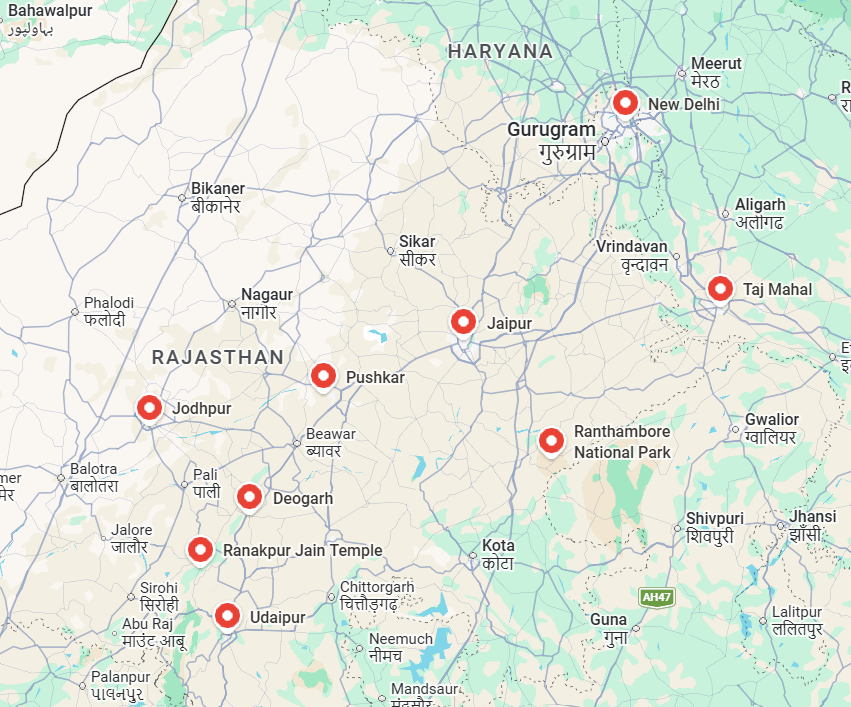
Trip map:
Udaipur
Udaipur also known as the "White City" or the "City of Lakes" is one of the most beautiful and spectacular cities in the state of Rajasthan. Nestled amidst green hills and surrounded by artificial lakes that enhance its magical atmosphere, the city features a network of lakes created by an advanced irrigation system in the 16th century; these lakes are an integral part of both the urban landscape and local culture.
The city's largest and most renowned lake is Lake Pichola, considered one of the most beautiful lakes in India. Located in the heart of the city, it is surrounded by magnificent palaces, green hills, and mountain peaks. A boat ride on the lake offers an unforgettable experience, especially at sunset, as the sun dips behind the mountains and its golden light reflects off the water.
During the boat ride, there is a special stop where you can disembark and marvel at one of the region's most spectacular sites the beautiful Jag Mandir Palace. Situated on a small island in the middle of the lake, the palace possesses a unique charm.
The palace walls are adorned with intricate sculptures and decorations, and the surrounding gardens are exquisitely manicured, offering visitors an experience of peace and tranquility.
Jag Mandir Palace hosts a variety of events, ranging from lavish weddings to conferences and cultural gatherings.
The City Palace
Located in the heart of Udaipur is the City Palace, a truly impressive palace built by Maharaja Udai himself. The palace is a prime example of Rajasthani architecture, featuring a unique design that blends elements of various styles, including Mughal architectural influences. The magnificent marblework adorning the palace is among the most impressive to be found anywhere, featuring intricate carvings and geometric patterns that enhance the site's lavish atmosphere.
The palace is exquisitely beautiful and meticulously designed, though it features numerous steep, narrow staircases. While these stairs may appear challenging, the climb is well worth the effort; each step leads to a new area offering spectacular vistas, rewarding visitors with breathtaking views of the city and the surrounding region.
Jagdish Temple
The Jagdish Temple is located just outside the Royal Palace. Built in the 17th century, the temple is dedicated to Lord Vishnu, one of the principal deities in Hinduism.
The Jagdish Temple features beautiful, complex carvings. The entrance is marked by a magnificent gateway decorated with sculptures and geometric patterns. The upper section of the temple features distinctive decoration that blends various styles of Indian art, with an emphasis on fine details that enhance the temple's visual richness. Inside, there is a statue of Vishnu adorned with jewelry and lavish attire.
The royal gardens
The royal gardens, Sahelion-Ki-Badi, were built in the 18th century and are considered one of the city's main attractions. Designed in the traditional Indian style, the gardens feature magnificent elephant fountains that enhance the site's unique atmosphere. Adorned with exquisite craftsmanship, the fountains reflect the artistry and culture of the era in which they were created.
In these royal gardens, noblewomen could stroll freely and enjoy the surrounding nature and beauty. They could also bathe in the clear-water pools, which served as a refuge from the intense summer heat.
Lakend Hotel
The hotel was once a magnificent palace situated on the banks of one of the region's most beautiful lakes. It features ornate walls, high ceilings, and luxurious chandeliers. Over the years, the hotel has undergone renovations and upgrades yet managed to preserve its historic character, which adds to its unique atmosphere (though it is a pity that maintenance is lacking).
In the morning, the hotel offers excellent, freshly made dosa. This Indian pancake made from lentils and rice is served hot and crispy with various sauces; it is a wonderful way to start the day.
Aroma Restaurant
A simple restaurant with a nice garden; the food is excellent, especially the Malai Kofta.
מסעדת 1559
One of the best and most beautiful restaurants we ate at in India; the courtyard is stunning, and the food is simply wonderful.
Nagda
Just outside Udaipur, in the town of Nagda, one can find the magnificent remains of two temples dedicated to the god Vishnu, bearing witness to the region's splendid architecture and rich culture.
The temples were destroyed during the Mughal invasions—campaigns notorious for their destructiveness and the invaders' capacity to obliterate local cultures. Amidst the grand terraces, one can observe exquisite stonework, spectacular sculptures, and intricate carvings.
Ranakpur
Located approximately 60 kilometers from the city of Udaipur is the Ranakpur Temple, one of the largest and most spectacular temples of the Jain faith. Considered a site of immense importance to Jain culture, the temple took decades to build, and the effort invested in it is evident in every single detail.
The construction process was complex and intricate, demanding great skill, patience, and advanced technical knowledge. Built between the 15th and 16th centuries, the project involved quarrying local stone, crafting and carving intricate details, and paying meticulous attention to every minute aspect.
The temple features hundreds of columns, each uniquely designed, lending the structure a distinctive and special appearance. Carved from granite, the columns are adorned with magnificent reliefs including figures of deities, geometric patterns, and scenes from daily life. The ceiling, too, is decorated with beautiful carvings that enhance the site's overall aesthetic. Light streaming through the temple windows reflects off these carvings, creating a magical and soothing atmosphere.
On the way to the temple, hundreds of friendly monkeys sit by the roadside; the moment your vehicle stops, they will immediately swarm toward it.

Deogarh
We traveled to Deogarh to experience authentic village life and went on a tour of a nearby village. We enjoyed seeing the locals happily waving and greeting us with "Ram Ram" (hello), as well as children dancing and singing in the streets. During the tour, we stopped at a picturesque lake, where our guide treated us to chai and cookies.
Jodhpur
Jodhpur is known as the "Blue City." This nickname stems from the city's many buildings, whose blue hue gives them a unique and striking appearance.
Founded in the 15th century by King Rao Jodha, Jodhpur quickly became a vital commercial and military hub. Over the years, a rich culture developed in the city, with the color blue becoming a symbol of high social status. Wealthy families would paint their homes blue to display their affluence and standing, creating the distinctive blue aesthetic that characterizes the city to this day.
The city's architecture blends various styles, featuring ornate wooden doors, windows with intricate latticework, and soaring turrets that enhance the overall look. The combination of the blue color and traditional architecture creates a magical atmosphere.
In my view, it is one of the most charming cities we visited on our trip, and I will undoubtedly return.
Jodhpur’s Mehrangarh Fort sits atop a high hill, encircled by an impressive wall that gives it a powerful and striking appearance.
Built in 1459 by Maharaja Rao Jodha, the fort’s architecture reflects the unique style of the era, featuring thick walls, magnificent towers, and arched windows.
The souvenir shop is truly special, offering a wide range of local items. It features not only unique souvenirs but also handicrafts by local artisans such as jewelry, traditional clothing, and art pieces. Every purchase supports a worthy cause; proceeds from sales are donated to local communities and various social projects.
The citys market is very colorful ; visiting in the morning makes for a calmer and more pleasant experience.
At the market entrance, there is a stall preparing samosas and kachoris—two very popular street foods (kachoris are particularly popular in the Jodhpur region). I admit I didn't dare eat at any street stall other than this one, but after our guide’s repeated assurances that the place was very clean and the food delicious, I gave it a try—and he was absolutely right.

Maharani Spices
On the street leading to the market, there is a large spice shop where you can find a variety of spices and teas, all of excellent quality.
Bishnoi Village
In Bishnoi a small town rich in cultural heritage residents engage in a unique, ancient form of craftsmanship. Passed down through generations, this craft is an integral part of the local identity, offering residents a way to preserve their ancestors' authentic traditions. The work is characterized by the use of traditional techniques and natural materials, lending the resulting products a distinctive quality.
With warm, broad smiles, the residents invite visitors to join them and learn about the creative process. They explain the significance of each stage from the selection of materials to the final creation of the products. Every item crafted here tells a story, embodying the spirit of the place and the traditions that define it.
The first stop on our visit was particularly interesting, as we attended an opium ceremony dedicated to the god Shiva. This ceremony, an integral part of local tradition, unfolds in a spiritual and impressive atmosphere. It offers a unique glimpse into the blend of tradition and faith. The ritual involves the use of opium symbolizing the connection between the physical and spiritual worlds which further enhances the event's mystical ambiance.
The jeep tour departed from the Ajit Bhawan Hotel, which features a charming courtyard, a good restaurant, and a display of vintage cars available for city tours.
Mandore garden
In the Mandore Gardens, one can find spectacular remains of various structures and temples that bear witness to the region's rich cultural history. The site offers a breathtaking panoramic view where nature and ancient architecture blend together, lending the place a unique and mysterious atmosphere. Among the structures, one can observe exquisite stonework, ancient sculptures, and inscriptions—each telling a story of the past.
The gardens themselves are well-tended and surrounded by lush vegetation, making a visit a pleasant and relaxing experience.
A large community of monkeys inhabits the area; they sit by the roadside, waiting for some sort of action.
Pushkar
Pushkar is a holy city for Hindus; they believe that bathing in the lake ensures physical and spiritual healing. The city is home to the only temple dedicated to the god Brahma—who, according to legend, cast a lotus flower that landed in the center of town, causing the lake to spring forth.
I couldn't quite grasp what people love about the city, aside from its holiness to Hindus. That said, it is a great place to people-watch and observe all sorts of interesting characters.
Since Pushkar is a holy city, no animal products are served there except for milk; not even eggs.
The market in Pushkar is very cheap—the most affordable we encountered on the entire trip so it’s the perfect place to buy souvenirs.
Some of the characters you meet in Pushkar
Out of the blue restaurant
"Out of the Blue" is fittingly for Pushkar a vegan restaurant; the food is excellent and the décor is truly unique. It was undoubtedly the cheapest restaurant we visited in India, offering great value just be prepared to climb quite a few steep stairs.
Cooking class
One of the highlights of my time in Pushkar was the Indian cooking workshop at Pushkar Cooking Art; everything was delicious and the atmosphere was very pleasant. Shivani is lovely and incredibly patient.
Jaipur
Jaipur, also known as the "Pink City," is a spectacular and fascinating place. It is distinguished by its unique beauty, with most of its buildings painted in shades of pink, giving the city a distinctive and stunning appearance.
Unlike many of the other cities we visited, Jaipur is very modern; it features contemporary buildings and even a modern shopping mall something that naturally delighted our daughters, as we were finally able to get them items from Sephora.
One of the city's famous landmarks is the Palace of Women, considered one of Jaipur's most impressive structures. Although visitors cannot go inside, its exterior is truly magnificent.
A few photos from the city.
Raj mandir cinima
Raj Mandir is the most magnificent cinema in India; all the seats are luxurious, comfortable armchairs, and the films are naturally Bollywood productions (for those who enjoy them). We happened to catch a Tamil movie, so we’d had enough of the experience after less than an hour, but it is definitely worth a visit.
Amber palace
Amber Fort, which towers high above the landscape, is one of India's most famous and impressive fortresses. It is located just a short distance from the city of Jaipur. One unique way to reach the fort is by riding an elephant, though we chose to arrive by car with our driver. Constructed from pink sandstone, the fort reflects a blend of Indian and Islamic artistic influences, evident in everything from its intricate windows to its meticulously carved decorations. Inside, one finds numerous mosaic ornaments that showcase the artistic and cultural richness of the era in which it was built. Every detail of the structure testifies to the immense effort invested by the artisans and builders, and their intricate craftsmanship is visible in every corner. It is also worth noting that the fort features many narrow, steep staircases, which may prove challenging for some visitors; however, the effort is certainly worthwhile.
Nahargarh palace
Nahargarh Palace is also situated atop the mountain, giving it a highly strategic location that allows it to overlook the entire city. The palace was built in the 18th century by King Sawai Jai Singh II. From the palace terrace, one can view the entire city of Jaipur.
The palace comprises ten rooms; one was designated for the king and meticulously designed to reflect his wealth and social status. The remaining nine rooms were intended for the king's wives, each decorated in a unique style that reflects the personal preferences of the individual occupant.
Citi palace
The City Palace of Jaipur, built in the 18th century, is one of the most impressive and spectacular landmarks in the Indian state of Rajasthan. Located in the heart of Jaipur, the palace serves not only as a popular tourist attraction but also as a museum dedicated to the region's history, culture, and arts.
The palace is distinguished by a unique architectural style that blends various influences. Constructed from pink sandstone, it boasts a distinctive and striking hue. A closer look reveals intricate design details, such as magnificent arches, windows adorned with stained glass, and stunning geometric carvings. Every element of the palace was carefully chosen, reflecting the opulence and grandeur of the royal family that once ruled the region.
The palace also serves as a museum, hosting various exhibitions dedicated to the history of Jaipur and the royalty of Rajasthan. It offers visitors displays of ancient weaponry, traditional attire, magnificent jewelry, and other unique artifacts that tell the story of the kings and queens who ruled the region. Visitors can appreciate the local craftsmanship, diverse culture, and rich history of the site.
Jantar Mantar
The Jantar Mantar astronomical garden is truly impressive, featuring numerous unique structures, each meticulously designed to enable the precise study of celestial bodies. Among the various structures, one can find advanced telescopes, instruments for measuring angles, and observation platforms that allow for a clear and comfortable view of stars and other celestial objects. A key function of the garden is the calculation of astrological charts based on the positions of the sun and stars in the sky. These charts serve not only the study of astronomy but also fields such as astrology, which holds that the positions of celestial bodies influence human life. Calculating these charts involves the use of various instruments that measure the positions of stars and planets in real time.
The astronomical garden also features various sundials, which serve as an excellent example of the blend of science and art. These sundials are constructed to indicate the precise time based on the sun's position in the sky. Each sundial is unique and often adorned with artistic designs that enhance its distinctiveness.
On the way to the car, we stopped at the Krishna temple to watch the Aarti ceremony undoubtedly a unique experience.
Bar Palladio
Bar Palladio is an Italian restaurant with Indian touches; the décor is beautiful, as are the dishes. While the food isn't the best I've ever had, it is tasty.
Ranthambore
Ranthambore National Park inspired Kipling when he wrote *The Jungle Book*; indeed, a visit to the park evokes the landscapes seen in the film. The reserve is home to tigers, bears, deer, and many other animals. Unfortunately, we didn't get to see a tiger; the weather was against us—it was a day with heavy fog, so the tigers weren't really out roaming or looking for water—but the reserve itself is beautiful.
Tours depart twice a day, and it is necessary to book a spot in advance.
Chand Baori
On the way to Agra, we stopped at a fascinating site called Chand Baori. It boasts the country's largest stepwell a structure that is not only massive but also breathtakingly beautiful. Built in the 8th century, the well was designed to store water during periods of drought. The architecture is extraordinary; the well features a stepped design leading to the bottom, ensuring easy access to the water even when the level was low. The steps are adorned with intricate artistic details, and the surrounding area contains numerous ruins of an ancient temple, adding a layer of mystery and intrigue to the site. The temple apparently once a significant center of worship bears witness to the rich and complex culture that flourished here in the past. It is remarkable how such a structure was built, especially considering that the well and temple date back to an era of very limited technology.
Bharatpur Bird Sanctuary
Another pleasant stop along the way is the Bharatpur Bird Sanctuary. Located in the Bharatpur region, this sanctuary is considered one of the most important and spectacular in India. It is home to a wide variety of bird species that attract nature enthusiasts and birdwatchers from around the globe. The sanctuary spans a vast area featuring lakes, wetlands, grasslands, and forests.
Fatehpur sikri
During his brief stay here, a vast complex of forts, palaces, and mosques sprang up; however, Akbar was ultimately forced to abandon his dream city due to a water shortage, and it became a ghost town.
The palaces and mosques were built in a unique architectural style that blends diverse traditions, such as Hindu and Islamic architecture. Among the city's notable structures is Akbar's palace featuring magnificent rooms, manicured gardens, and other buildings which reflects the wealth and architectural prowess of the era.
Agra
Agra is a crowded, noisy, and very unimpressive city; the only reason to visit is to see the Taj Mahal otherwise, you can certainly skip it.
Agra Fort
Agra Fort is also architecturally distinctive; one of its most prominent features is the Islamic influence on its architecture and design. The magnificent entrances, intricate arches, and elaborate wall decorations reflect the Mughal style, which blends Islamic elements with local traditions.
In addition to Islamic influences, Agra Fort also showcases Hindu elements that reflect India's rich cultural heritage. Sculptures and figures representing Hindu deities, as well as patterns and ornaments associated with Hindu tradition, can be found at the fort's entrances and within its interior spaces.
Taj Mahal
The Taj Mahal, one of the most famous and spectacular structures in the world, was built as a magnificent mausoleum by the Maharaja to honor the memory of his beloved wife, who passed away while giving birth to their son. The Maharaja was so heartbroken by her loss that he decided to build a structure expressing his deep love for her a decision that transformed the Taj Mahal into a symbol of eternal love. The building is truly impressive, featuring rich, colorful mosaic work.
One amusing detail is that the moment it comes into view, everyone raises their hands to snap a photo it’s treated just like a celebrity.

Molecule bar
In Agra, we went to a really cute rooftop bar called Molecule great music, good food, and a great atmosphere.
Delhi
Delhi is divided into Old Delhi and New Delhi; the new city is very impressive, featuring expansive roads and sidewalks, a well-kept appearance, and beautiful, modern restaurants. In contrast, the old city is very crowded, congested, and dirty though, of course, still worth a visit.
Old Delhi
The Old Delhi market at Chandni Chowk is incredibly colorful and diverse, offering a wide variety of goods and bustling with activity; the market features numerous stalls selling spices of every type and aroma. According to family stories, my late grandfather used to travel all the way from Baghdad to source these spices and sell them back home.
One of the best and most famous stalls is Kumar Spices.
The Sikh Temple
Gurudwara Bangla Sahib is the most prominent Sikh temple in Delhi; it is vast and truly impressive. The temple hosts daily free meals known as "Langar," which are open to everyone regardless of religion, race, or economic status. Thousands of people dine here every day, and these meals serve as a wonderful example of the values of equality and brotherhood that lie at the heart of the Sikh faith. One of the most unique experiences here is visiting the temple kitchen to witness the cooking process firsthand. The kitchen operates around the clock, with volunteers working together to prepare massive quantities of food.
Gandhi's House
This house was not only the home of Mahatma Gandhi but also a setting for significant political and cultural developments. Today, the house serves as a museum dedicated to Gandhi’s life and legacy. The tragic assassination on January 30, 1948, marked a turning point not only for India but for the entire world. In the garden, one can see the final steps he took before being shot. The house has become a symbol of sorrow, yet also a place of remembrance and inspiration, reminding us of the importance of the struggle for justice and freedom. Visitors can view photographs, documents, and personal belongings that once belonged to Gandhi; together, they paint a portrait of a man who dedicated his life to the cause of peace, love, and brotherhood among nations.
The Bahá'í Lotus Temple
A beautiful Baha'i temple in Delhi; the structure itself is composed of 27 lotus petals, each made of concrete clad in granite and other materials, giving it a radiant and distinctive appearance. Its advanced architectural design blends modern and traditional elements, and it is considered one of Delhi's most famous architectural landmarks.
True to the Baha'i tradition, it is set amidst a beautiful, well-manicured garden.
Akshardham temple
The Akshardham Temple is beautiful and impressive; the structure itself is built of pink sandstone and evokes India's historic palaces, featuring intricate ornamentation and magnificent sculptures that depict scenes from Indian history and mythology. Situated within a vast complex, the site offers boat rides that showcase the history of India, as well as an impressive fountain show.
Please note that nothing including mobile phones may be taken inside the temple; therefore, the photos here are not my own but are from the temple's official website.
Qutab minar
The Qutub Minar is a spectacular and unique site located in Delhi, the capital of India. Considered one of the country's most important historical landmarks, it combines magnificent architecture with a rich and diverse history. Standing 75 meters tall, it was the highest tower of its era and is built in the Islamic architectural style. The tower rises to an impressive height and consists of five distinct stories, each adorned with intricate stonework and unique carvings. In fact, each level showcases a different design style, lending the structure a truly distinctive character.
Cedar restaurant
Cedar Restaurant features beautiful décor and great food; it is highly recommended. The same owners also run a charming brewery called CCH, where the food is excellent as well.
Lazeez Affaire restaurant
An excellent restaurant; the dishes here are the tastiest we’ve had in India. The biryani is served in a pot and is truly unique, and the stuffed potato dish Banarasi Dum Aloo is simply divine.
👑 Golden Tips: A Quick Summary for Travelers to Rajasthan
A trip to Rajasthan ("Land of Kings") is a rollercoaster of colors, scents, and rich culture. To help you experience it as smoothly and enjoyably as possible, I’ve put together the most important tips I learned along the way:
Travel in January 📅the weather is simply perfect: not too hot and not rainy.
Hire a private driver 🚗—especially if you’re short on time (two weeks or less); it offers peace of mind and a sense of security.
Don’t let the initial shock faze you 😮; the sights, smells, and sounds upon arrival can be overwhelming, but give it two or three days, and the magic of India will reveal itself to you.
Watch what you eat 🍛; Indian street food is an experience, but unless a local guide vouches that a spot is 100% clean, it’s best not to take the risk.
Pushkar has only vegetarian food 🥦; remember that this holy city is entirely free of animal products (not even eggs), though it is the cheapest place to buy souvenirs.
Save some energy for the stairs 🏰; the palaces and forts (like those in Udaipur and Jaipur) are stunningly beautiful, but exploring them involves climbing steep, narrow staircases.
India is a land of contrasts that isn't always easy to process, but the experiences and sights you take away from here will stay with you for a lifetime.
Comments